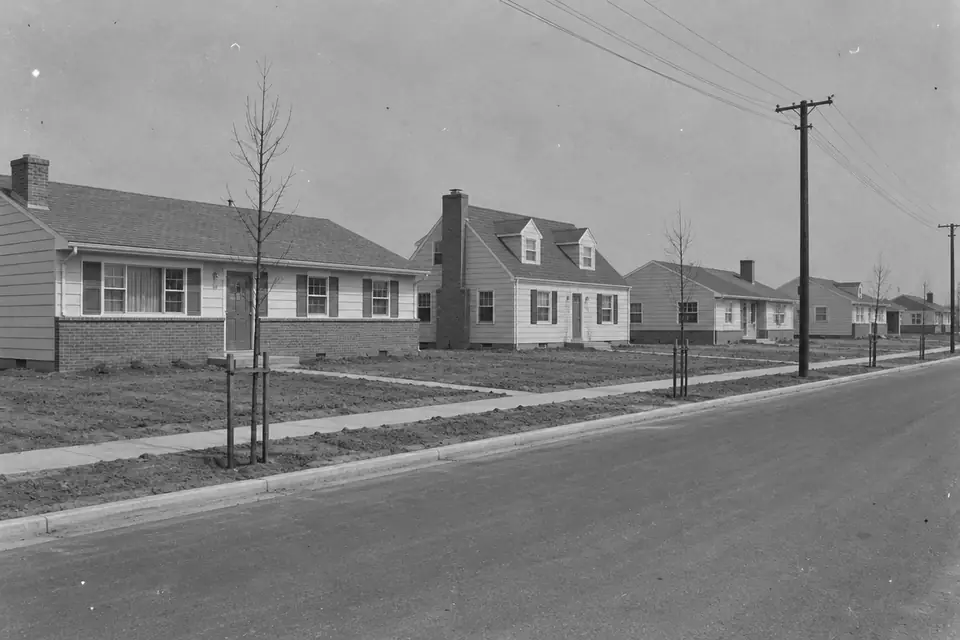
Willingboro is not a town that grew. It is a town that was assembled, almost all at once, by one builder, and then renamed twice. Everything about the map follows from that.
Before Levitt
The township was incorporated in 1798 as Wellingborough. It stayed small and rural for a century and a half. In 1959 the population was roughly 10,000 people.
After the Second World War, demand for affordable new housing changed the equation. William Levitt had built Levittown on Long Island and another in Pennsylvania, both spread across several towns with different zoning rules. He decided his next project would sit inside a single town.
The land
In 1954, Levitt's agents optioned and then bought much of Wellingborough. By 1956 the company had acquired 90 percent of the township. That year the state legislature redrew the municipal boundaries, which is why the township's shape is what it is: the Westampton line on one side, Route 130 on another, the Burlington Township line on a third and the Rancocas Creek on the fourth. The village of Rancocas was annexed to Westampton in the same act.
This is the detail that explains the modern map. A single plan, drawn once, across one municipality, with a consistent street pattern, a consistent housing stock and a set of sections each with its own name.
Two names in four years
In 1959 residents voted, by a margin of 80 votes, to rename the township Levittown. In 1963, a second referendum changed it to Willingboro.
The color line and the case that ended it
Levitt's development was segregated. The township's master plan records it plainly: although New Jersey law prohibited discrimination in housing supported by federal subsidies, Levitt declared he would not sell to Black buyers.
In 1958, W.R. James, a Black Army officer, applied to buy a home here despite that policy and filed suit against Levitt and Sons. The New Jersey Supreme Court ruled in his favor, and the first Black family moved into the township.
That is not a footnote. It is the reason the town's later history looks the way it does, and the reason the federal Fair Housing Act and the New Jersey Law Against Discrimination are the standard this site is written to.
Peak, and the long shift
By 1970 the township had more than 43,000 residents, its highest count. The master plan notes that as the share of residents of color increased, white flight led many residents to leave. The population today is around 33,000.
What this means for a buyer in 2026
You are buying into a coherent mid-century town, not a collection of unrelated subdivisions. The houses are of one era, which makes comparing them easier. The sections are of one plan, which makes the town learnable in a week. And the town's history is documented, which means you can read the primary sources instead of relying on a sales pitch, this page included.
Sources: Willingboro Township, Township History (crediting the Willingboro Public Library); Willingboro Township Master Plan additional information, both accessed November 2026.
Have a question this page did not answer?
Ask it directly. If it is a legal, tax, mortgage, appraisal or inspection question, you will be pointed to the licensed professional who handles it rather than given an answer here.